
The moment learning becomes useful is usually the moment it stops feeling smooth. You close the book and the definition won't come. You start the problem and realize you don't know the first move. You play the passage and your fingers miss the same transition again.
We tend to read that resistance as evidence that the session is going badly. Then we reach for the fastest way around it: reopen the notes, reveal the answer, slow the video down, ask AI to finish the step. The discomfort goes away. So does the work that would have made the next attempt easier.
Your brain is not saving a file
Learning is often described as putting information into memory, as if the brain were a drive and studying were a transfer bar. Skill is much more physical than that. When a circuit is recruited again and again, the system changes how efficiently that circuit operates.
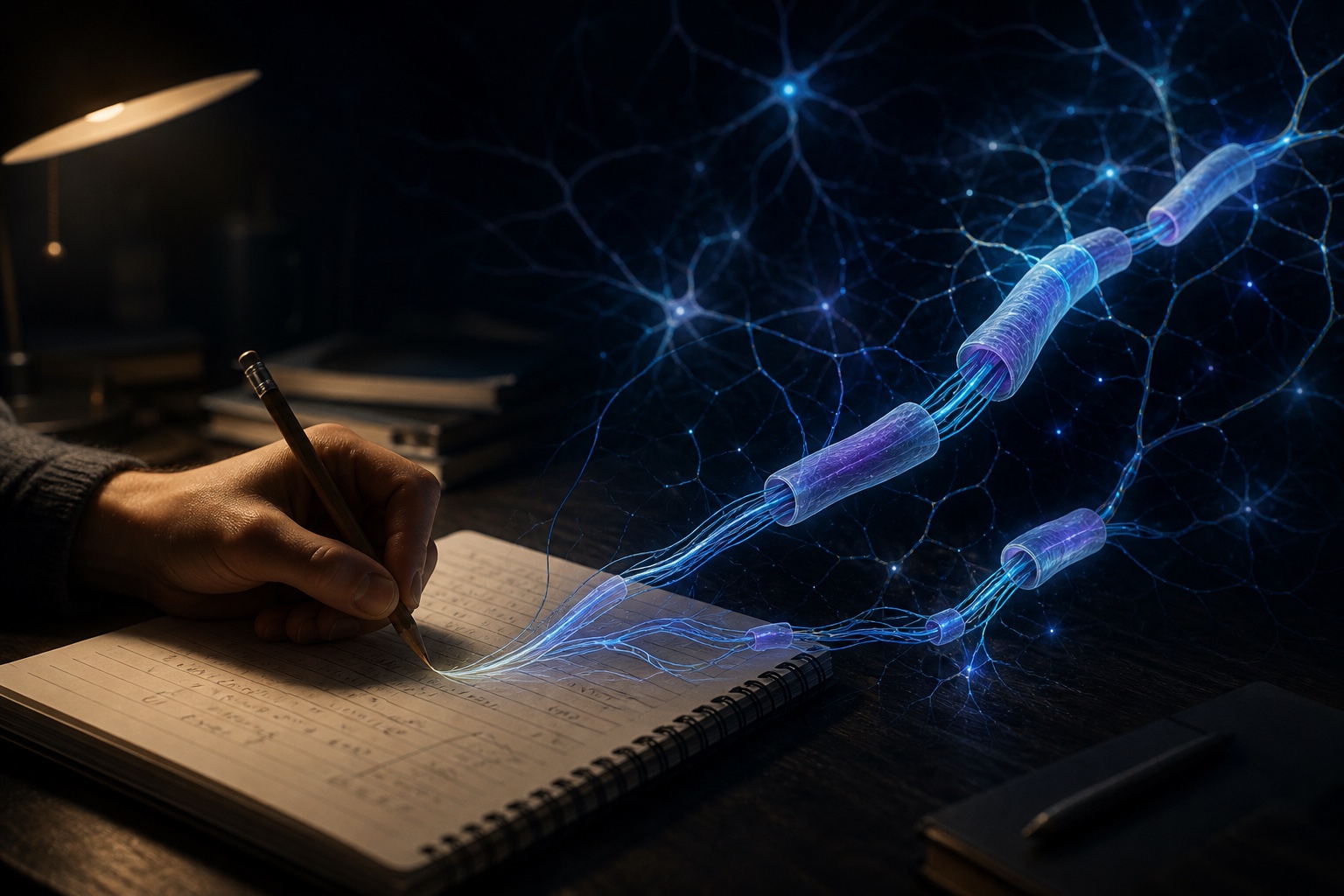
One part of that change is myelination. Myelin is a fatty insulating sheath wrapped around many axons, the long fibers neurons use to send signals. It helps those signals travel faster and more reliably. Practice can influence myelin-forming cells and the organization of white matter, alongside many other forms of plasticity happening at synapses and across networks.
This does not mean one hard algebra problem visibly coats a neuron in myelin. The biology is slower, messier, and more distributed than the metaphor. But the direction matters: repeated use is not merely recording an idea. It is helping tune the machinery that carries the idea.
The struggle is not proof that learning failed. It is the request for the circuit to change.
Friction tells the brain what to build
Productive friction forces a circuit to do something. Retrieval makes you reconstruct an answer without the answer in view. A difficult problem makes you choose a path instead of recognizing one. Corrective feedback exposes the exact difference between the circuit you ran and the one the task required. Another attempt runs the revised path.
That loop of attempt, error, correction, and another attempt is why practice has to contain resistance. If an interface predicts every word, completes every derivation, and offers help before uncertainty has time to form, the experience can feel wonderfully efficient while the learner's own circuitry stays mostly idle.
Easy is not always bad. Once a skill has been built, speed and automaticity are the point. The mistake is trying to borrow the feeling of automaticity before doing the repetitions that create it.
Keep the right friction
Not all difficulty teaches. A broken login, an unclear prompt, illegible feedback, or a tool that makes you hunt through menus consumes attention without improving the target skill. Good learning design removes that kind of friction and preserves the kind that makes the learner produce.
- Hide the answer until there is an attempt. Even an incomplete attempt gives feedback something real to correct.
- Make retrieval ordinary. A blank page is more diagnostic than another pass through highlighted notes.
- Repeat the repaired move. Understanding a correction is not the same as being able to execute it next time.
- Space the return. Let a little forgetting create the need to rebuild, rather than keeping the answer warm in working memory.
This is the kind of friction we want in Lune Synth™. The app should make it easy to capture work, understand feedback, and know what to practice next. It should not make it easy to skip the attempt. Your handwriting, your wrong turn, your second pass: those are not obstacles between you and learning. They are the material learning is made from.
Want a study tool that protects the useful struggle? Join the beta waitlist on the Lune Synth home page, or write to griffin@lunesynth.com.