Answer in Arabic
Write by hand on paper or the in-app canvas, or type. Answers are graded as text; Lune Synth does not score pronunciation.

Lune Synth for Arabic
Arabic hides most of its vocabulary inside roots: د ر س sits under دَرَسَ (he studied), دَرَّسَ (he taught), مَدْرَسَة (school) and دِراسَة (study), and a learner who only recognises each word separately never sees the shape underneath. Lune Synth gives you right-to-left dialogues with translations and one line missing, and root-and-pattern tables where you name the three letters a family of words shares, then feedback on the exact letter or pattern that went wrong.

Where Arabic learners get stuck
An app that drills كتب as one flashcard never asks you to see that كاتب (writer), مكتوب (written) and مكتبة (library) all stand on the same three letters in a different pattern. Reading diacritics that a native text never prints, or tapping a translation you half-recognise, doesn't build that skill. Pulling the root out of a word you've never seen, and predicting the pattern of a word you need, does.
Practice that reads the way Arabic reads
Questions can carry a short dialogue in Arabic script, laid out right to left with an English translation under each turn and one reply missing, or a root-and-pattern table that lines up a verb's forms and its derived nouns so you can name the three letters they all share. The asked piece stays a question mark, never pre-filled.
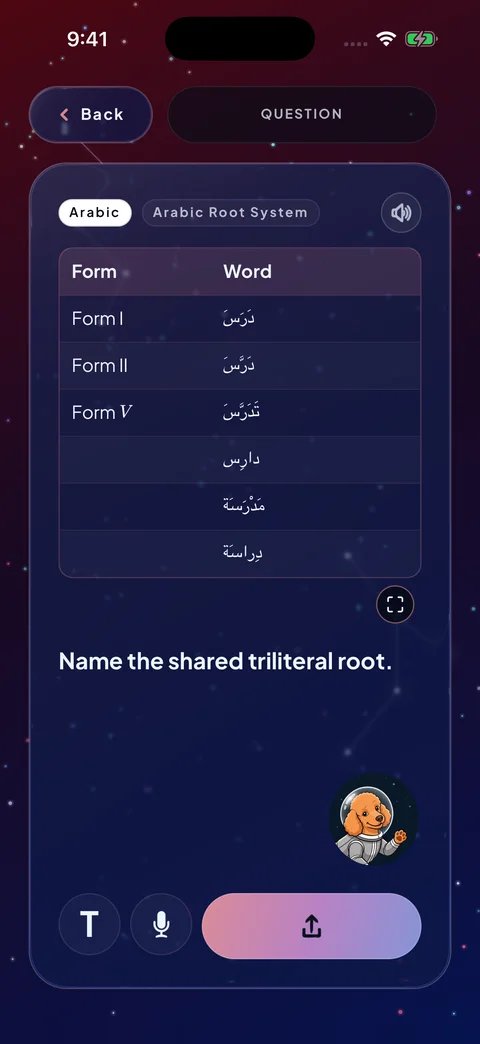
Captured from the Lune Synth app. Generated question sets can include a diagram when one helps; figures go through automated checks against the question before they are shown. Root-and-pattern tables are checked for structure (the asked root not printed elsewhere in the table), not recomputed by a morphology model. Lune Synth does not grade pronunciation or short-vowel diacritics you choose not to write.
Luna voice call
Speak it out loud. Luna answers in Arabic, asks a follow-up and corrects the one slip worth fixing.
The Lune Synth loop
Write by hand on paper or the in-app canvas, or type. Answers are graded as text; Lune Synth does not score pronunciation.
Feedback separates a wrong root letter from a wrong pattern, and a verb form from the noun it derives.
A quick mission goes after it: Form I versus Form II verbs, or nouns built from one root.
One attempt. One useful next step.
الجذر هو دَرَسَ
دَرَسَ is the whole Form I verb, not the root. Strip the vowels and the pattern to isolate د ر س.
Every form in the table keeps the same three consonants in the same order. Which three are they?
Next mission: five roots, naming the three letters behind a verb and a noun each.
Join the beta for Arabic practice built around right-to-left dialogues, root-and-pattern tables and the reasoning behind each form.