Answer in Mandarin
Write characters by hand on paper or the in-app canvas, or type pinyin or characters. Answers are graded as text; Lune Synth does not score your spoken tones.

Lune Synth for Chinese (Mandarin)
Mandarin packs its hardest ideas into small things: a pitch contour that turns mother into horse, a character you have to recognise without pinyin, a measure word that changes with the noun. Lune Synth draws tone contours on a pitch chart, gives you dialogues with pinyin under each line, and pairs new characters with their pinyin on picture cards.

Where Mandarin learners get stuck
Tone mistakes are easy to miss on your own because the syllable still sounds familiar. Characters are the same: pinyin underneath every line feels like reading until it is taken away. Seeing the contour drawn, naming it yourself, and recognising characters before you lean on the pinyin builds the skill that holds up.
Practice that looks like the language
Questions can draw tone contours on the five-level pitch scale with one contour asked, carry a dialogue in characters with pinyin under each line and one word missing, or show picture cards with each character word and its pinyin.
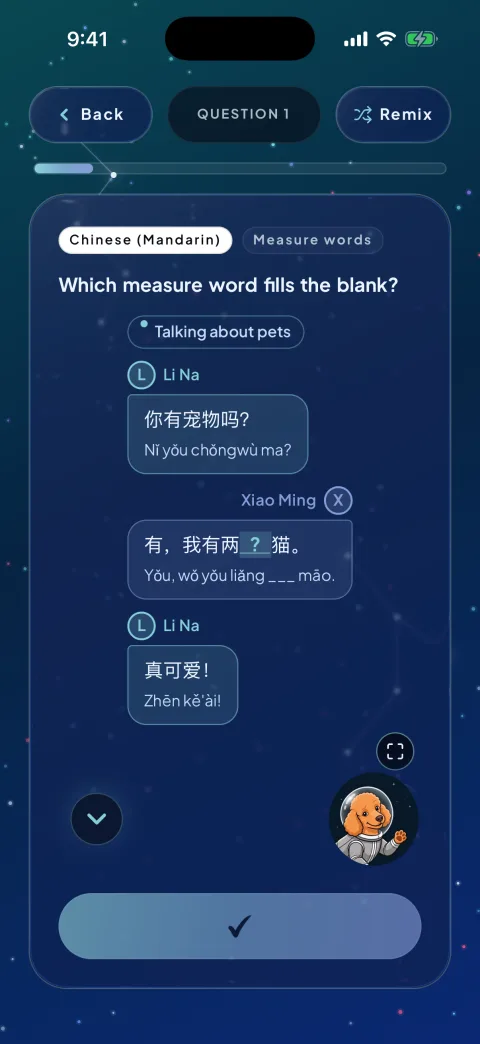
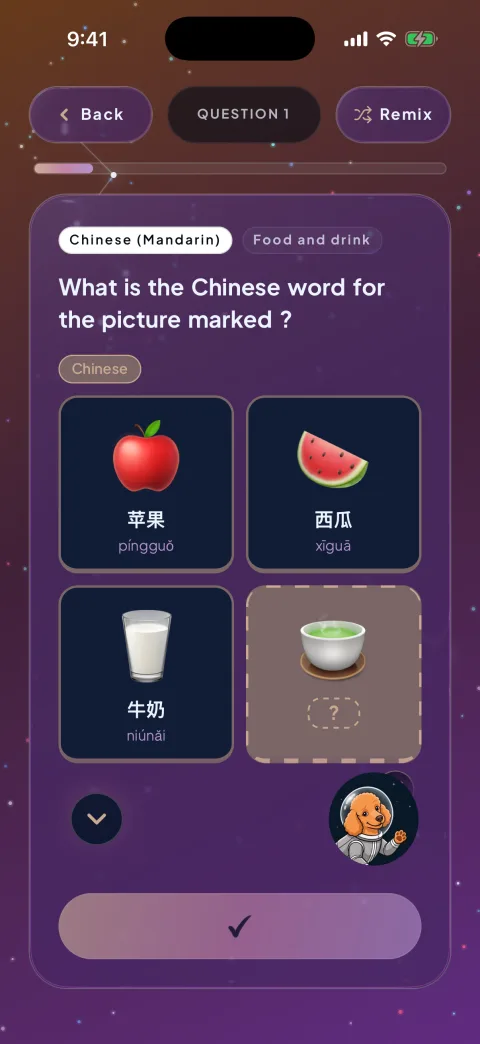
Captured from the Lune Synth app. Generated question sets can include a diagram when one helps; figures go through automated checks against the question before they are shown. Tone contours are drawn from a fixed table of the four tones and the neutral tone; a chart where tone sandhi would change the contour is not drawn. Picture cards draw every word from a reviewed vocabulary list, not from the model. Lune Synth does not check stroke order.
Luna voice call
Speak it out loud. Luna answers in Chinese, asks a follow-up and corrects the one slip worth fixing.
The Lune Synth loop
Write characters by hand on paper or the in-app canvas, or type pinyin or characters. Answers are graded as text; Lune Synth does not score your spoken tones.
Feedback separates a wrong tone from a wrong character, and a wrong measure word from a wrong noun.
A quick mission targets it: second versus third tones, common measure words, or characters you keep reading by pinyin.
One attempt. One useful next step.
我有两个猫。
个 is the general measure word, but animals such as cats usually take 只.
Which measure word goes with most animals?
Next mission: eight nouns, each with its usual measure word.
Join the beta for Mandarin practice built around tone contours, dialogues with pinyin and characters learned with their readings.