Write the whole sentence
Write on paper or the in-app canvas, type, or answer by voice. Answers are graded as text; Lune Synth does not score pronunciation.

Lune Synth for Dutch
Dutch drops case endings almost entirely but keeps two things English speakers never predict right: an article, de or het, that has to be memorised per noun rather than derived from a rule, and a verb that splits in two, with the particle or infinitive pushed to the very end of the clause. Lune Synth gives you sentences that show the article beside the noun and sentences with the split verb's second half missing, with feedback on exactly which piece went wrong.

Where Dutch learners get stuck
Roughly three in four Dutch nouns take de, so guessing de gets you far enough to never notice het boek, het huis and het meisje going wrong. Reading the article in a sentence someone else wrote doesn't fix that; producing it yourself, word by word, is the only way the exceptions stop being surprises.
Practice built around articles and word order
Questions can carry a conversation that shows de or het beside the noun, or a conversation with the separable verb's particle left blank at the very end of the clause.
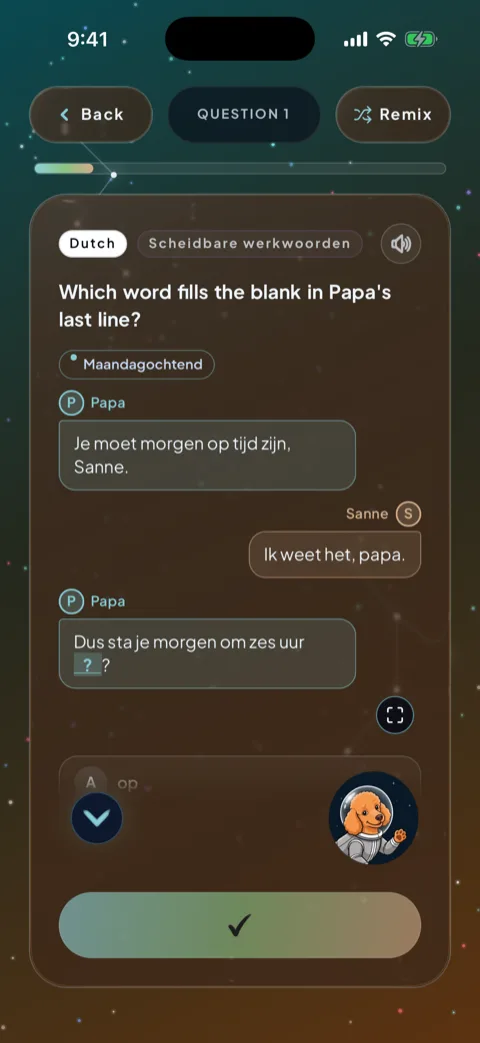
Captured from the Lune Synth app. Generated question sets can include a diagram when one helps; figures go through automated checks against the question before they are shown. Lune Synth does not grade pronunciation.
Luna voice call
Speak it out loud. Luna answers in Dutch, asks a follow-up and corrects the one slip worth fixing.
The Lune Synth loop
Write on paper or the in-app canvas, type, or answer by voice. Answers are graded as text; Lune Synth does not score pronunciation.
Feedback separates a wrong article from a verb particle left in the wrong place.
A quick mission goes after it: ten het-words that break the de default, or five separable verbs.
One attempt. One useful next step.
Ik bel mijn moeder op morgen.
Opbellen splits: op belongs at the very end of the clause, after morgen, not right after bel.
In a main clause, where does the second half of a separable verb go?
Next mission: six sentences with opbellen, opstaan and aankomen.
Join the beta for Dutch practice built around articles, separable verbs and the reasoning behind each piece.