Write the form
Write on paper or the in-app canvas, type, or answer by voice. Dictation is transcribed and graded as text; Lune Synth does not score your pronunciation.

Lune Synth for French
French grammar hides in small pieces: avoir or être, a past participle that agrees or doesn't, le or la behind an l'. Lune Synth gives you conjugation tables with a form to complete, café-style conversations with a missing reply, and picture cards that show the gender an elision hides.

Where French learners get stuck
Much of French grammar is silent: finis, finit and fini sound alike, and l'école never tells you it is feminine. Listening alone will not fix that, and neither will a flashcard that shows the answer after one tap. Writing the form out, then seeing exactly which letter or agreement is off, does.
Practice that looks like the language
Questions can carry a conjugation table with the asked form left blank, a short exchange with one reply missing, or picture cards that tag the gender wherever l' hides it. The missing piece stays a question mark until you supply it.
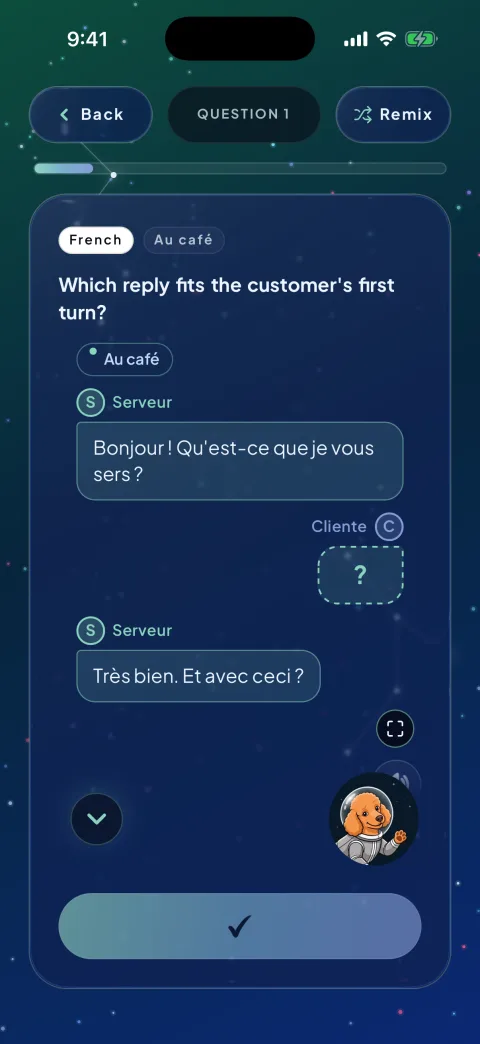
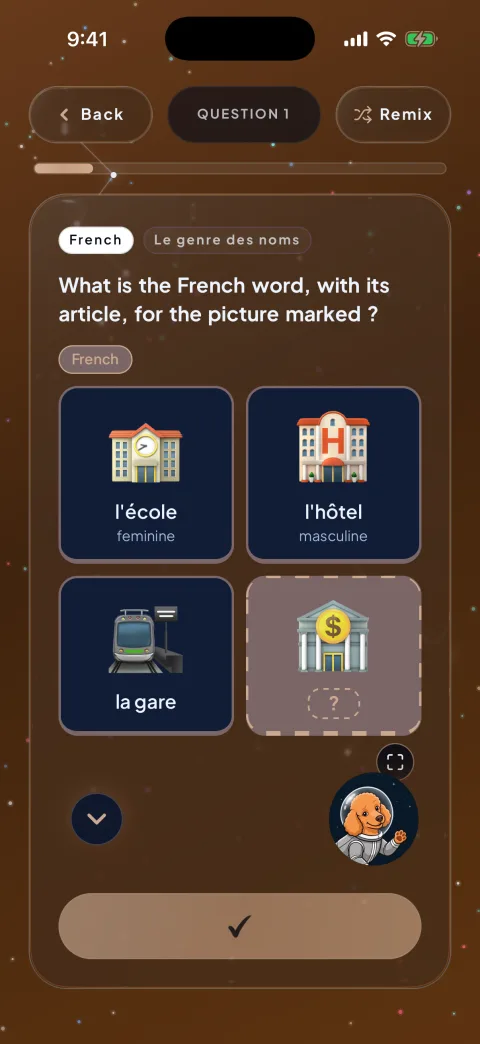
Captured from the Lune Synth app. Generated question sets can include a diagram when one helps; figures go through automated checks against the question before they are shown. Tables for regular verbs are recomputed by the app's own conjugation model, and a table with a form that disagrees is dropped; irregular verbs are checked for structure only. Picture cards draw every word from a reviewed vocabulary list, not from the model.
Luna voice call
Speak it out loud. Luna answers in French, asks a follow-up and corrects the one slip worth fixing.
The Lune Synth loop
Write on paper or the in-app canvas, type, or answer by voice. Dictation is transcribed and graded as text; Lune Synth does not score your pronunciation.
Feedback names the piece that broke: the auxiliary, the participle ending, the agreement or the article.
A quick mission targets it: être verbs, -ir versus -re participles, or nouns whose gender you keep guessing.
One attempt. One useful next step.
Hier soir, nous avons finit nos devoirs.
The auxiliary is right. The past participle of finir is fini; finit is the present tense.
Which ending do -ir verbs take in the past participle?
Next mission: six passé composé sentences with -ir and -re verbs.
Join the beta for French practice built around conjugation tables, conversations and the agreements that are easy to miss.