Build the ending
Write on paper or the in-app canvas, type, or answer by voice. Dictation is transcribed and graded as text; Lune Synth does not score your pronunciation.

Lune Synth for German
German asks three questions before every article: which gender, which case, which number. Lune Synth gives you article and case tables with one ending to supply, conversations where a preposition decides between dative and accusative, and picture cards that show each noun with der, die or das.

Where German learners get stuck
Most learners can recite der, den, dem, des and still write mit den Freund, because the hard part is not the table: it is deciding which row the sentence needs. Wo or wohin, subject or object, a preposition that always takes the dative. Practise the decision, and the ending follows.
Practice that looks like the language
Questions can carry an article or conjugation table with the asked cell left blank, a short dialogue where one article depends on the preposition, or picture cards with each noun's gender shown. The missing piece stays a question mark until you supply it.
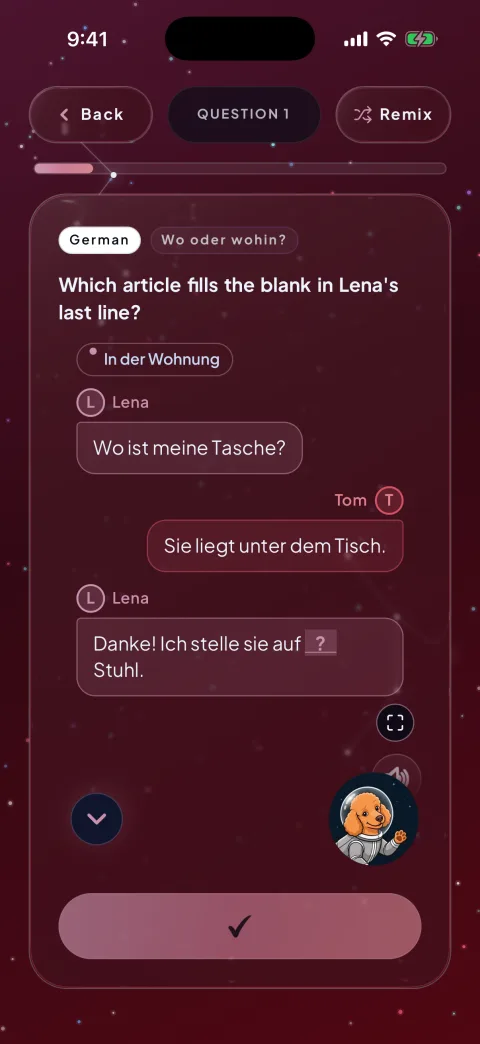
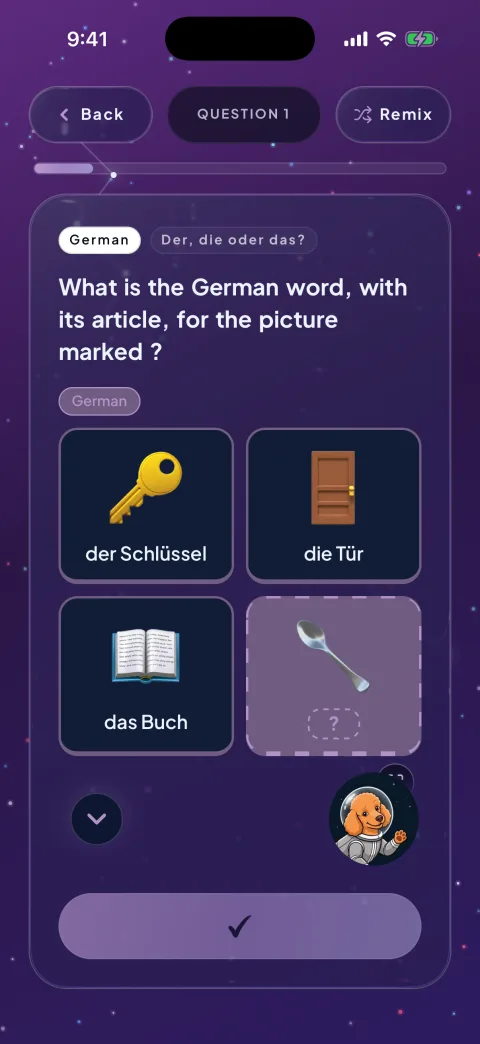
Captured from the Lune Synth app. Generated question sets can include a diagram when one helps; figures go through automated checks against the question before they are shown. Article tables and tables for regular (weak) verbs are recomputed by the app's own model, and a table that disagrees is dropped; strong and irregular verbs are checked for structure only. Picture cards draw every word from a reviewed vocabulary list, not from the model.
Luna voice call
Speak it out loud. Luna answers in German, asks a follow-up and corrects the one slip worth fixing.
The Lune Synth loop
Write on paper or the in-app canvas, type, or answer by voice. Dictation is transcribed and graded as text; Lune Synth does not score your pronunciation.
Feedback separates a wrong gender from a wrong case, and a wrong case from a word-order slip.
A quick mission drills that decision: two-way prepositions, dative verbs, or accusative masculine endings.
One attempt. One useful next step.
Ich stelle die Tasche auf dem Stuhl.
Stuhl is masculine and the article form exists, but stellen describes movement onto the chair, so auf takes the accusative here.
Is the bag already on the chair, or moving onto it: wo or wohin?
Next mission: eight two-way preposition sentences, wo versus wohin.
Join the beta for German practice built around case tables, conversations and the decisions behind every ending.