Build the form yourself
Write on paper or the in-app canvas, type, or answer by voice. Answers are graded as text; Lune Synth does not score pronunciation.

Lune Synth for Greek
Modern Greek keeps a case system like Latin's, nominative, genitive, accusative and vocative, carried by the article as much as the noun. Then it layers on something Latin doesn't ask for: most verbs have two stems, one for an ongoing or repeated action and one for a single completed action, so "I was writing" and "I wrote" aren't just different endings, they're different words. Lune Synth gives you article-and-noun declension tables and aspect-pair tables with one stem missing.

Where Greek learners get stuck
έγραφα (I was writing, imperfective) and έγραψα (I wrote, perfective) both translate as a simple English past tense, so a learner reading a dialogue can glide past the distinction entirely. Choosing between the two stems only becomes automatic once you've had to build each one yourself, in a sentence that forces the choice.
Practice built around case and aspect
Questions can carry an article-and-noun declension table across the four cases with one cell blank, or a verb's perfective and imperfective forms side by side with one stem left out.
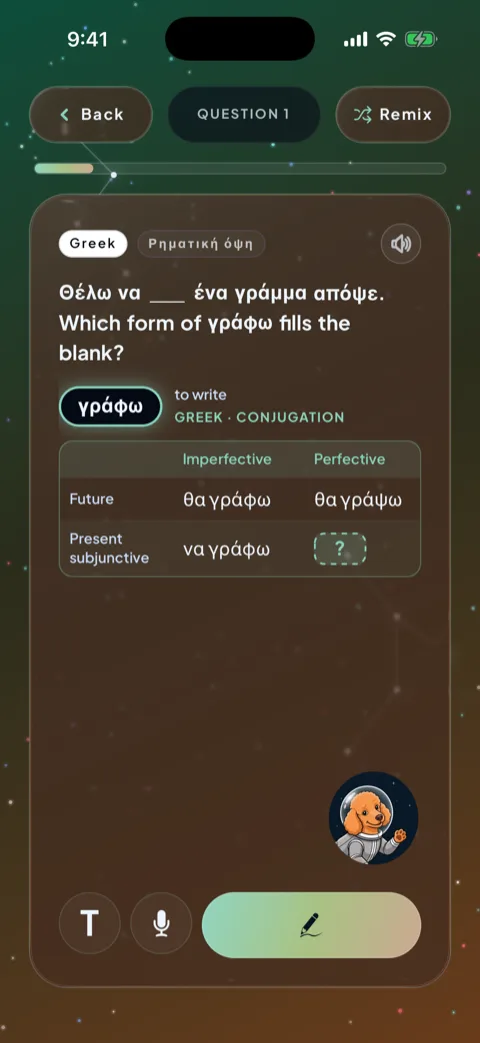
Captured from the Lune Synth app. Generated question sets can include a diagram when one helps; figures go through automated checks against the question before they are shown. Lune Synth does not grade pronunciation or accent placement.
Luna voice call
Speak it out loud. Luna answers in Greek, asks a follow-up and corrects the one slip worth fixing.
The Lune Synth loop
Write on paper or the in-app canvas, type, or answer by voice. Answers are graded as text; Lune Synth does not score pronunciation.
Feedback separates a wrong case ending from the wrong verb stem for the aspect the sentence needs.
A quick mission goes after it: genitive versus accusative, or perfective versus imperfective stems.
One attempt. One useful next step.
Χτες έγραφα ένα γράμμα και το έστειλα.
The letter gets finished and sent, a single completed action, so the first verb needs the perfective: έγραψα.
Did the writing stay unfinished, or did it end before the sending happened?
Next mission: six sentences choosing between imperfective and perfective past.
Join the beta for Greek practice built around case, aspect and the reasoning behind each form.