Answer in Japanese
Write by hand on paper or the in-app canvas, or type. Answers are graded as text; Lune Synth does not score pronunciation or stroke order.

Lune Synth for Japanese
Japanese asks you to juggle three scripts, a particle after almost every noun, and a plain or polite form for every verb. Lune Synth gives you short dialogues with readings and one particle missing, plain and polite verb tables with a form to complete, and picture cards that pair each kanji word with its kana reading.

Where Japanese learners get stuck
Particles carry the meaning that English puts in word order and prepositions, so a single wrong one changes the sentence. Reading kanji with the furigana always on, or tapping the particle that looks familiar, does not build the choice. Supplying it yourself, in a sentence with a clear meaning, does.
Practice that looks like the language
Questions can carry a dialogue in Japanese script with a romaji line under each turn, a table of plain and polite forms with one cell blank, or picture cards that show each kanji word with its kana reading. The asked piece stays a question mark.
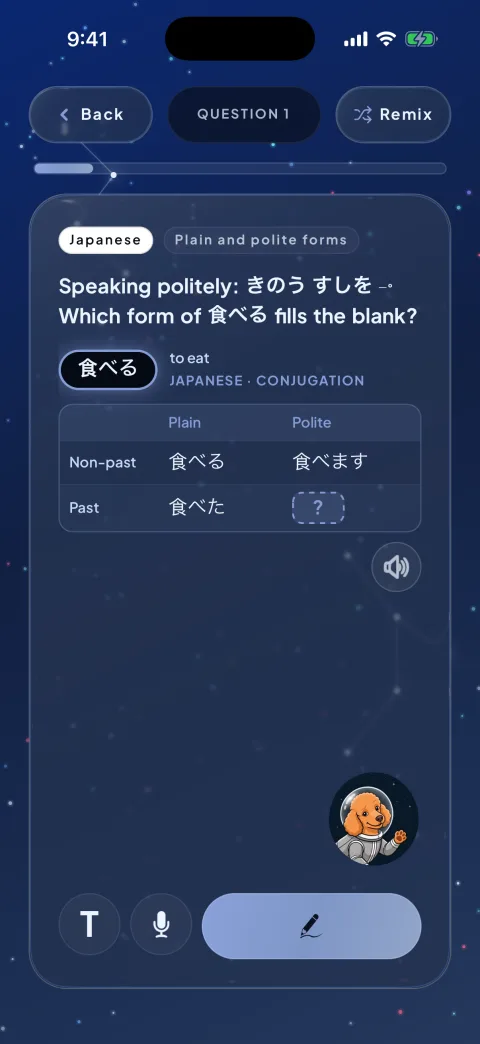
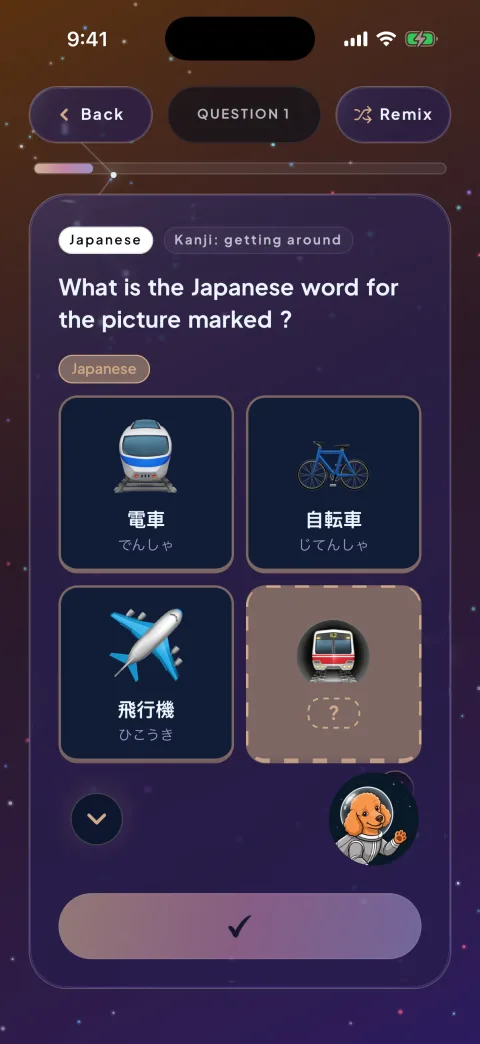
Captured from the Lune Synth app. Generated question sets can include a diagram when one helps; figures go through automated checks against the question before they are shown. Picture cards draw every word from a reviewed vocabulary list, not from the model. Lune Synth does not check stroke order.
Luna voice call
Speak it out loud. Luna answers in Japanese, asks a follow-up and corrects the one slip worth fixing.
The Lune Synth loop
Write by hand on paper or the in-app canvas, or type. Answers are graded as text; Lune Synth does not score pronunciation or stroke order.
Feedback separates a wrong particle from a wrong verb form, and a plain form where the situation needs a polite one.
A quick mission goes after it: に versus で, は versus が, or polite past forms.
One attempt. One useful next step.
バスに 行けますか。
The sentence asks how Ken can get there. に marks a destination; the means of travel takes で.
Is the bus where Ken is going, or how he is going?
Next mission: eight sentences choosing between に and で.
Join the beta for Japanese practice built around dialogues with readings, plain and polite forms, and kanji you learn with their kana.