Answer in Korean
Write Hangul by hand on paper or the in-app canvas, or type. Answers are graded as text; Lune Synth does not score pronunciation.

Lune Synth for Korean
Hangul is logical once you see how each block is built, and Korean grammar asks a second question in every sentence: who are you talking to? Lune Synth shows syllable blocks as jamo tiles with one block to build, tables of plain and polite verb forms, and conversations where the reply has to match the listener.

Where Korean learners get stuck
Learners often stop at reading Hangul by sound and memorising one verb ending, then use 반말 with a teacher or a stiff form with a friend. The fix is practising the choice: the same sentence, a different listener, a different ending. Building blocks and endings yourself makes both automatic.
Practice that looks like the language
Questions can show syllable blocks as jamo tiles with one block or one jamo to supply, a table of plain and polite forms with one cell blank, or a conversation with romanization where one reply is asked.
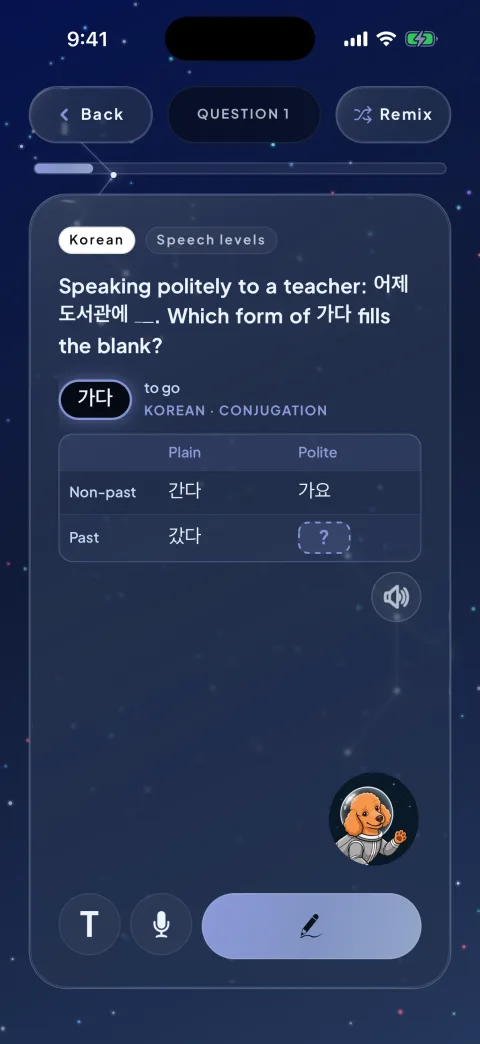
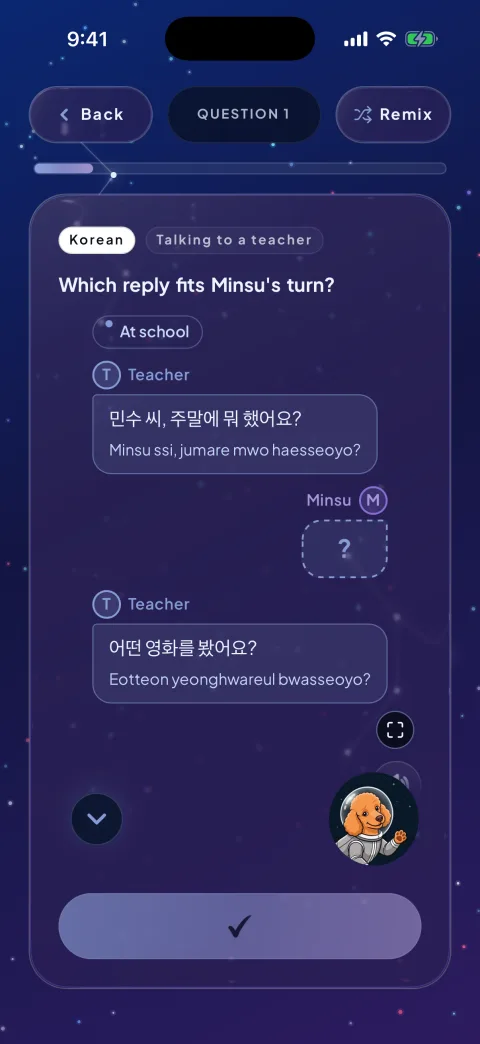
Captured from the Lune Synth app. Generated question sets can include a diagram when one helps; figures go through automated checks against the question before they are shown. Hangul blocks are checked against their jamo by the Unicode composition rule, and romanizations against Revised Romanization, before they are shown.
Luna voice call
Speak it out loud. Luna answers in Korean, asks a follow-up and corrects the one slip worth fixing.
The Lune Synth loop
Write Hangul by hand on paper or the in-app canvas, or type. Answers are graded as text; Lune Synth does not score pronunciation.
Feedback separates a wrong tense from a wrong speech level, and a wrong jamo from a wrong block.
A quick mission targets it: polite past endings, 반말 versus 존댓말, or blocks with final consonants.
One attempt. One useful next step.
선생님, 친구하고 영화 봤어.
The past tense is right, but 봤어 is casual speech. Talking to a teacher calls for the polite 봤어요.
Who is Minsu talking to, and which ending fits that relationship?
Next mission: six replies, each to a friend and then to a teacher.
Join the beta for Korean practice built around Hangul blocks, speech-level tables and conversations where register matters.