Parse it yourself
Write the form, the case and your translation on paper or the in-app canvas, or type it.

Lune Synth for Latin
Latin puts the grammar in the endings: one letter separates the subject from the object, and the word order will not rescue you. Lune Synth gives you declension and conjugation tables with macrons and a form to complete, and glossed sentences from authors like Caesar where you explain one word's case.

Where Latin students get stuck
Chanting declensions is a start, but translation fails when a student reads dominī as a plural subject when it is a genitive, or treats in + accusative like in + ablative. The skill is identifying the form in context and saying why. That is what written practice with feedback trains.
Practice that looks like the language
Questions can carry a declension or conjugation table with macrons and one form left blank, or a sentence glossed word by word, interlinear style, with the gloss of the asked word left as a question mark.
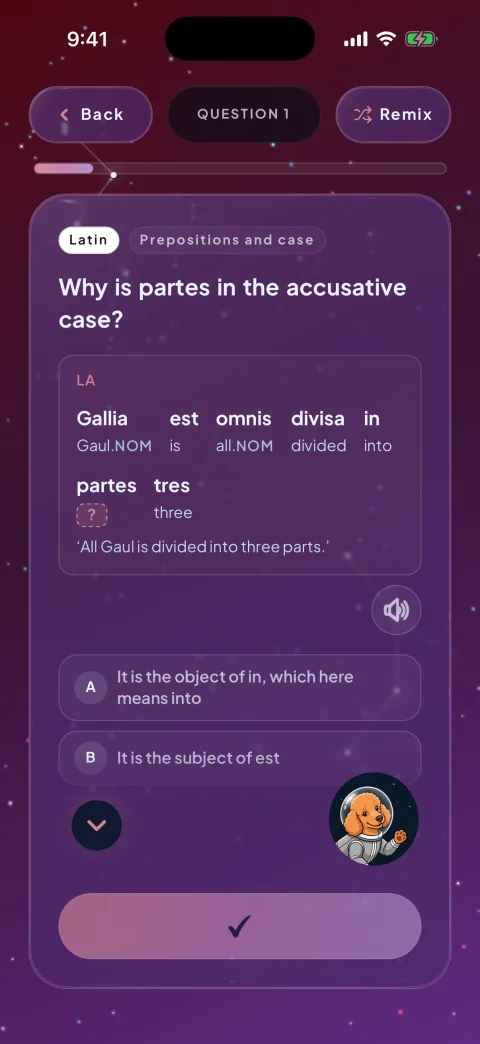
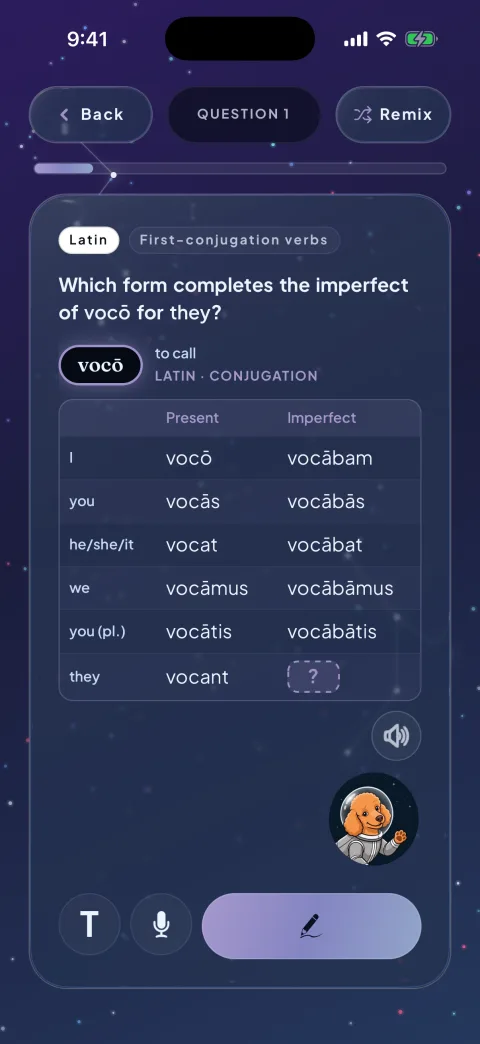
Captured from the Lune Synth app. Generated question sets can include a diagram when one helps; figures go through automated checks against the question before they are shown. Latin tables are checked for structure (one form per cell, the asked form not printed elsewhere), not recomputed. Scansion is something you write out yourself; the Latin pages do not draw a metrical diagram.
Luna voice call
Speak it out loud. Luna answers in simple classroom Latin, fixes the ending that slipped and explains how the words sound.
The Lune Synth loop
Write the form, the case and your translation on paper or the in-app canvas, or type it.
Feedback separates a misidentified case from a wrong ending, and a wrong ending from a translation that ignores the construction.
A quick mission targets it: genitive versus nominative plural, prepositions with two cases, or imperfect endings.
One attempt. One useful next step.
partēs: ablative plural, because it comes after in.
In can take either case. With the accusative it means into, which is what divisa in partēs trēs needs; the ablative plural would be partibus.
Does in here mean position or motion into?
Next mission: six prepositional phrases, in and sub with each case.
Join the beta for Latin practice built around declension tables, glossed sentences and the reasoning behind each case.