Produce the form
Write on paper or the in-app canvas, type, or answer by voice. Dictation is transcribed and graded as text; Lune Synth does not score your pronunciation.

Lune Synth for Portuguese
Brazilian Portuguese verbs change fast across tenses, and nós falamos looks the same in the present and the past. Lune Synth gives you conjugation tables with a form to complete, everyday exchanges with a missing reply, and picture cards in Brazilian Portuguese with each noun's article.

Where Portuguese learners get stuck
Many learners, especially Spanish speakers, can follow Portuguese long before they can produce it, and the forms they produce borrow from the wrong language. Writing the verb yourself in a sentence that needs it shows you where the borrowing slips in.
Practice that looks like the language
Questions can carry a conjugation table with the asked form left blank, a short exchange at a padaria with one reply missing, or picture cards that use Brazilian vocabulary such as o trem and o metrô.
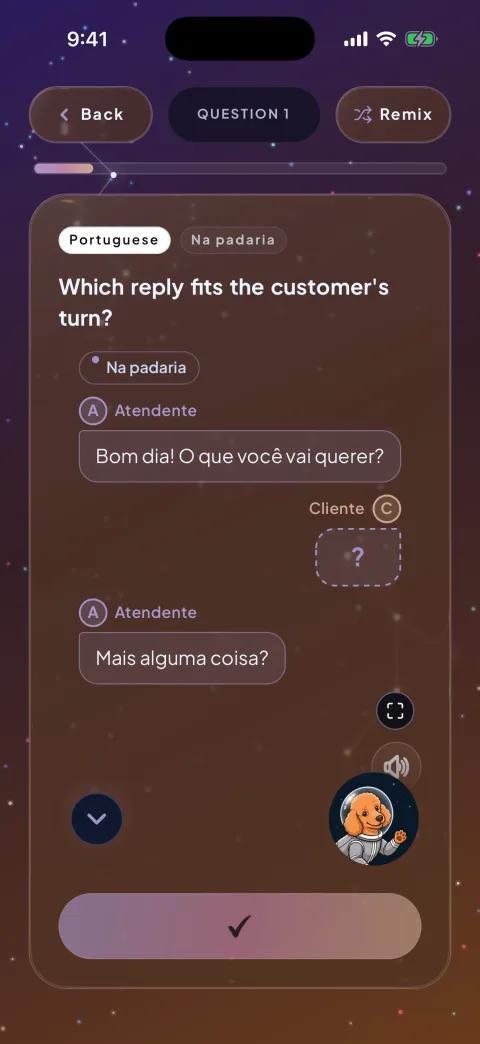
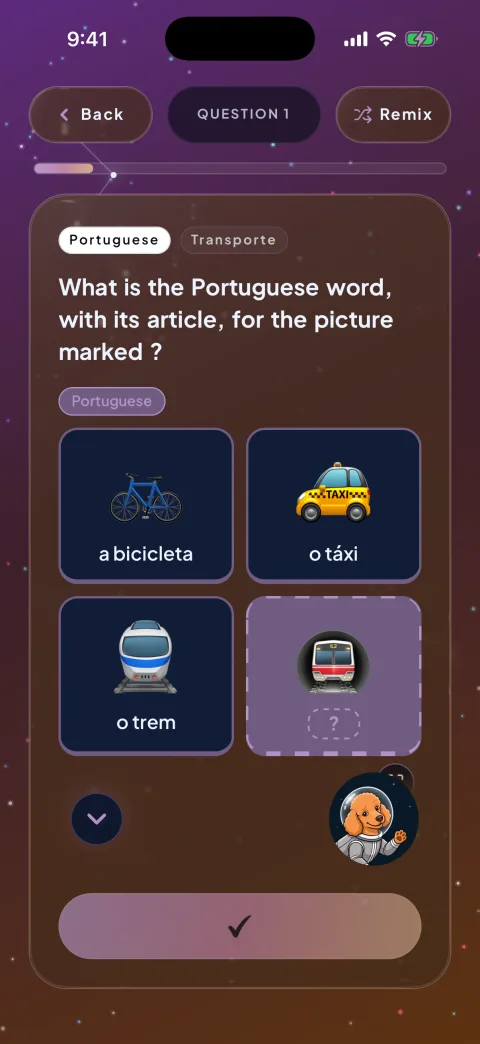
Captured from the Lune Synth app. Generated question sets can include a diagram when one helps; figures go through automated checks against the question before they are shown. Tables for regular verbs are recomputed by the app's own conjugation model, and a table with a form that disagrees is dropped; irregular verbs are checked for structure only. Picture cards draw every word from a reviewed vocabulary list, not from the model.
Luna voice call
Speak it out loud. Luna answers in Portuguese, asks a follow-up and corrects the one slip worth fixing.
The Lune Synth loop
Write on paper or the in-app canvas, type, or answer by voice. Dictation is transcribed and graded as text; Lune Synth does not score your pronunciation.
Feedback separates a wrong tense from a wrong person, and a Spanish ending from a Portuguese one.
A quick mission drills it: preterite endings, ir + infinitive, or nouns whose gender differs from Spanish.
One attempt. One useful next step.
Ontem eu falé com a minha avó por telefone.
The tense is right, but falé is not a Portuguese form: the eu preterite of -ar verbs ends in -ei.
How does the eu form end in the pretérito perfeito: falou, falei or falé?
Next mission: six eu and ele forms in the pretérito perfeito.
Join the beta for Brazilian Portuguese practice built around conjugation tables, conversations and everyday vocabulary.