Produce the form
Write on paper or the in-app canvas, type, or answer by voice. Dictation is transcribed and graded as text; Lune Synth does not score your pronunciation.

Lune Synth for Spanish
Speak Spanish out loud and Luna corrects the one slip worth fixing, gently, in the moment. Then tighten it on paper with Lune Synth: pick the tense, conjugate the verb, and see the exact written form that still needs work.

Where Spanish learners get stuck
Multiple-choice apps train recognition: you can spot comió in a lineup and still write comía in a sentence that needs the preterite. The gap shows up when you speak or write, because nobody hands you four options. Building the form yourself, and knowing which rule picked it, is what closes that gap.
Practice that looks like the language
Questions can carry a short conversation with one line or one verb missing, a conjugation table with the asked form left blank, or picture cards for new vocabulary with the article shown. The missing piece stays a question mark, so the figure sets up the problem without giving the answer away.
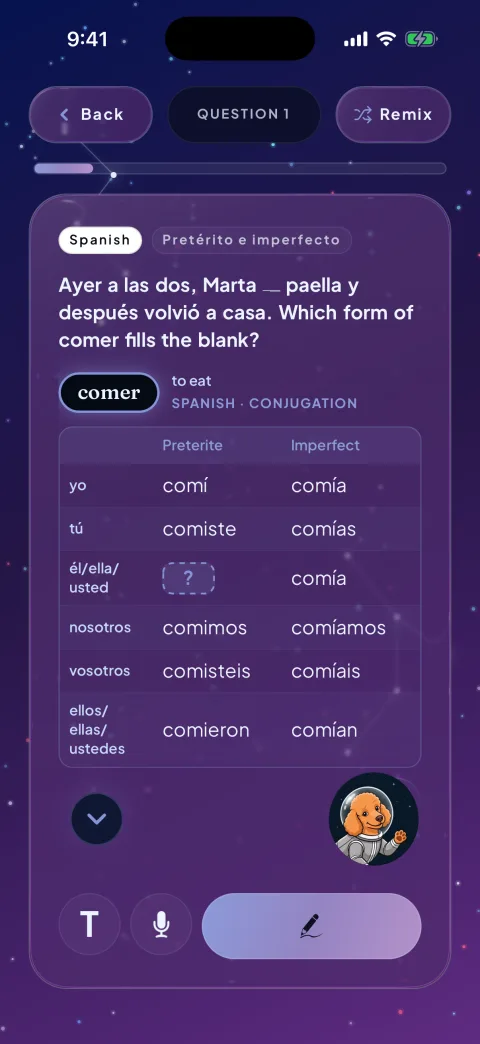
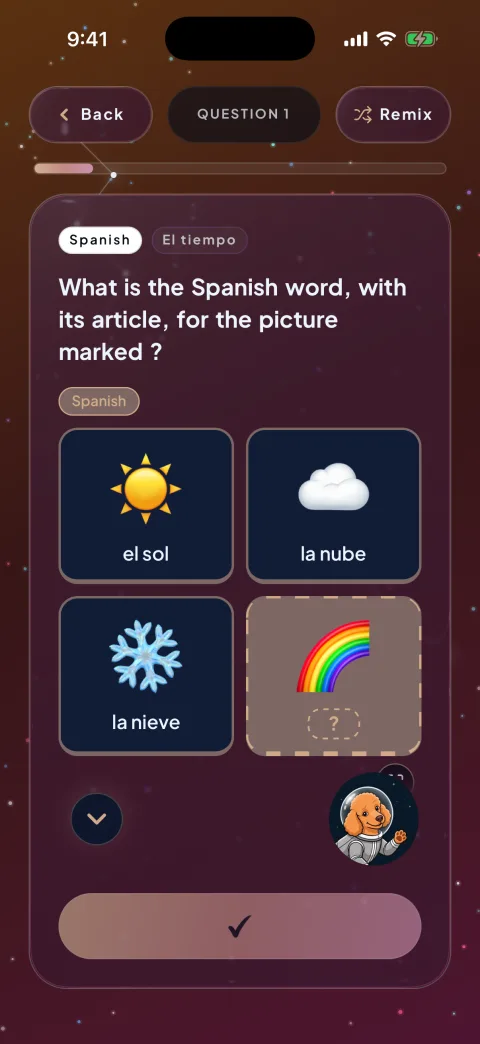
Captured from the Lune Synth app. Generated question sets can include a diagram when one helps; figures go through automated checks against the question before they are shown. Tables for regular verbs are recomputed by the app's own conjugation model, and a table with a form that disagrees is dropped; irregular verbs are checked for structure only. Picture cards draw every word from a reviewed vocabulary list, not from the model.
Luna voice call
Speak it out loud. Luna answers in Spanish, asks a follow-up and corrects the one slip worth fixing.
The Lune Synth loop
Write on paper or the in-app canvas, type, or answer by voice. Dictation is transcribed and graded as text; Lune Synth does not score your pronunciation.
Feedback separates the wrong mood from the wrong person, a missed spelling change (llegues, not llegas) from a missed accent.
A quick mission goes after that pattern: subjunctive triggers, preterite versus imperfect, or gender and agreement.
One attempt. One useful next step.
Es importante que tú llegas temprano.
The person is right, but es importante que calls for the subjunctive, and llegar adds a u to keep the hard g.
After es importante que, which mood does the next verb take?
Next mission: five subjunctive triggers with spelling-change verbs.
Join the beta for Spanish practice built around conversations, conjugation tables and the reasoning behind each form.