Produce it yourself
Write on paper or the in-app canvas, type, or answer by voice. Questions can be read aloud. Answers are graded as text; Lune Synth does not score pronunciation.

Lune Synth for languages
Speak out loud in the language you're learning and Luna answers back, asks a follow-up, and corrects the one slip worth fixing. Then Lune Synth asks for the other half: write the verb form, choose the case, or supply the particle you'd otherwise just recognise.

Why language apps plateau
Tapping the option that looks right trains you to recognise a form, not to produce it when no options are offered. The gap appears the first time you write or speak. Lune Synth closes it by asking you to build the form yourself, then telling you which rule picked it.
Each language gets its own diagrams
Questions can carry a dialogue with one line missing, a conjugation or case table with one cell blank, picture cards for new words, Mandarin tone contours, or Hangul blocks built from their parts. Pages by language: Spanish, French, German, Italian, Portuguese, Japanese, Chinese (Mandarin), Korean, Latin, English (ESL), Arabic, Russian, Hindi, Dutch, Greek.
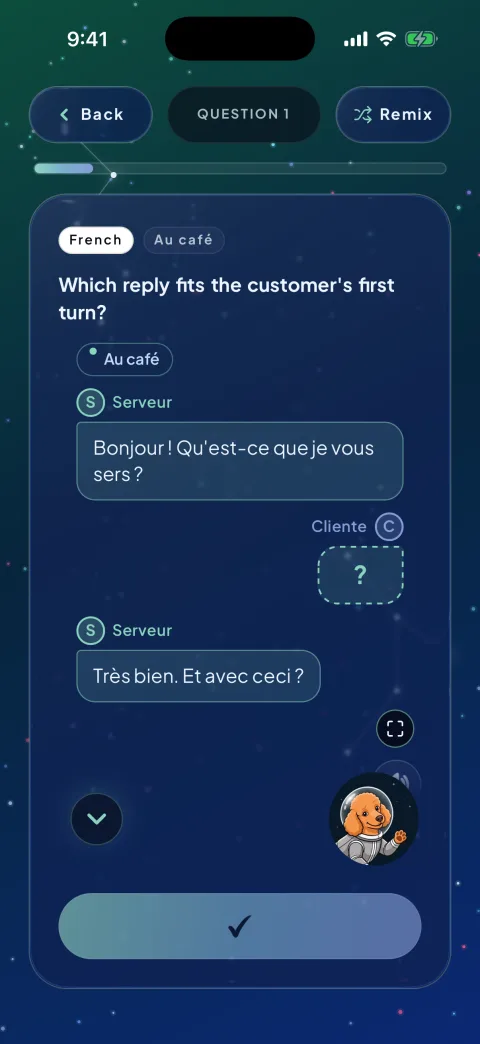
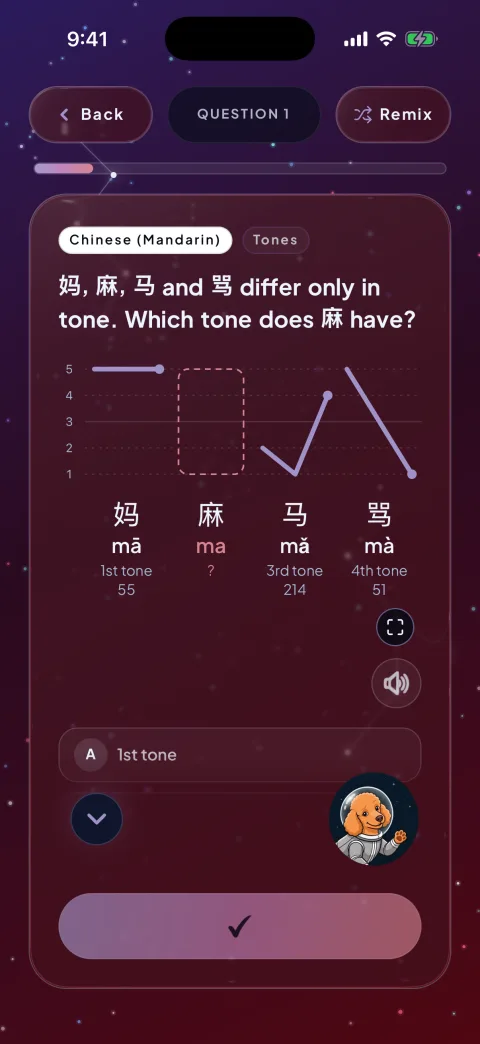
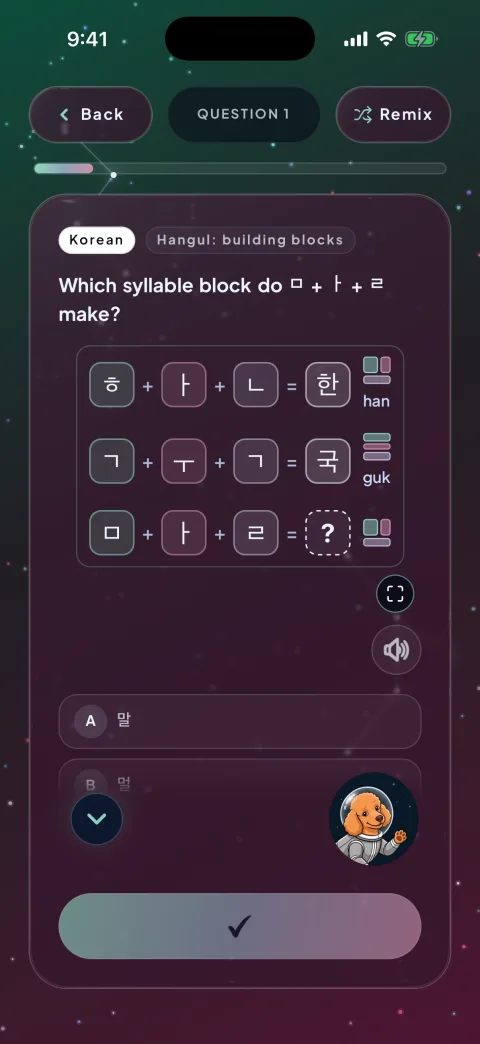
Captured from the Lune Synth app. Generated question sets can include a diagram when one helps; figures go through automated checks against the question before they are shown. Regular-verb tables in Spanish, French, Italian, Portuguese and German are recomputed by the app's own model before they are shown. Picture cards draw every word from a reviewed vocabulary list, not from the model.
Luna voice call
Speak it out loud. Luna answers in the language you're learning, asks a follow-up and corrects the one slip worth fixing.
Scripted sample calls on the app's voice-call screen. Lune Synth does not score pronunciation.
The Lune Synth loop
Write on paper or the in-app canvas, type, or answer by voice. Questions can be read aloud. Answers are graded as text; Lune Synth does not score pronunciation.
Feedback names the form, ending, particle or tone that went wrong, and the rule that decides it.
A quick mission drills the pattern you missed, in sentences that need it.
One attempt. One useful next step.
Ich stelle die Tasche auf dem Stuhl.
Stellen describes movement onto the chair, so auf takes the accusative: auf den Stuhl.
Is the bag already on the chair, or moving onto it?
Next mission: eight two-way preposition sentences, wo versus wohin.
Join the beta for language practice built around conversations, tables, scripts and the reasoning behind each form.